

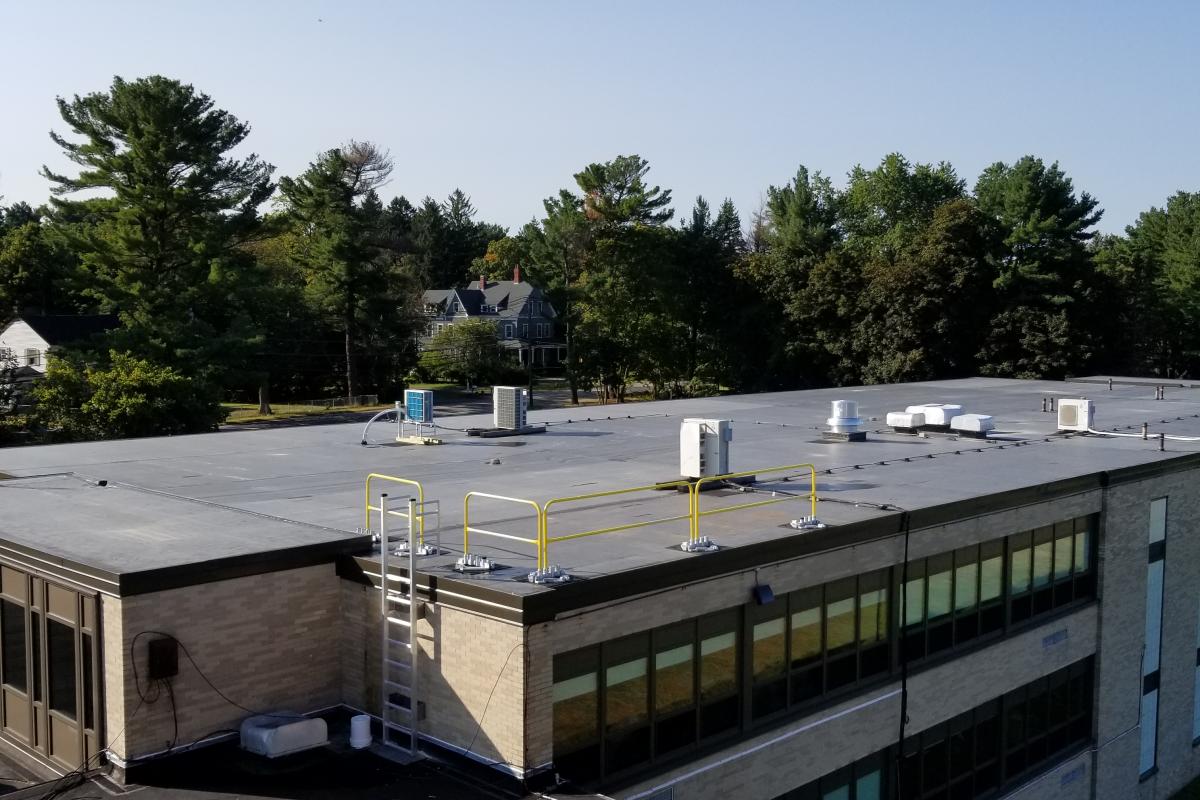
Government and Municipal Building Roofing starts with the condition of the roof in front of us
Commercial roofing for government buildings, municipal facilities, and public infrastructure.
Grand Rapids maintains an extensive inventory of city-owned and county-owned facilities across Kent County, defined by the Gerald R. Ford Federal Building on Monroe Avenue NW, the Kent County Courthouse complex, Grand Rapids City Hall on Monroe Center, and a network of fire stations, police precincts, and branch library locations that stretch from the Westside neighborhood to the East Hills corridor. Roofing projects on these public facilities operate under Michigan's Construction Lien Act as well as the requirements of Michigan Compiled Laws Section 125.1581, which governs competitive bidding for municipal construction contracts. The City of Grand Rapids Purchasing Division publishes formal bid invitations through the Michigan government procurement portal, and contractors must hold a valid Michigan residential roofing license or be registered as a commercial contractor under the Michigan Department of Licensing and Regulatory Affairs before any contract can be executed.
West Michigan's climate is one of the most demanding roofing environments in the Great Lakes region. Grand Rapids receives an average of 72 inches of snow annually, driven by lake-effect precipitation off Lake Michigan, and the weight loads on flat-roofed municipal buildings during heavy accumulation events regularly exceed 30 pounds per square foot. The City's Engineering Services Division has updated structural load documentation for older municipal buildings after several roof failures on commercial structures in the region during the winter of 2019, and contractors working on City facilities are now required to submit a snow load analysis prepared by a licensed structural engineer before any reroof scope of work is finalized. Beyond snow loading, the freeze-thaw cycling that characterizes Grand Rapids winters - where temperatures can swing across the 32-degree threshold 80 to 100 times per year - creates particular stress at parapet flashings, roof drains, and expansion joint covers on older brick-and-masonry civic buildings.
The City of Grand Rapids has made energy performance a centerpiece of its municipal facilities strategy through its adopted Climate Action Plan, which commits to carbon neutrality in city operations by 2030. Reroofing projects on city buildings are expected to achieve specific R-value improvements as part of the work scope, and the Facilities Management Division has developed a standard specification that requires a minimum of 4 inches of continuous polyisocyanurate insulation on all new low-slope roof assemblies. The plan also encourages the integration of rooftop solar photovoltaic arrays on municipal buildings, and contractors submitting roofing proposals on larger facilities like the Water Treatment Plant or Public Services Center may be asked to provide a supplemental cost proposal for ballasted or mechanically-attached solar-ready assemblies that accommodate future PV installation without voiding the membrane warranty.
Historic preservation considerations are particularly significant in Grand Rapids, which has one of Michigan's most active historic district programs. The Heritage Hill Historic District immediately east of downtown contains a number of municipally-owned or municipally-leased buildings, and the Monroe Center streetscape includes several structures in the Downtown Grand Rapids Overlay District. Roofing work on contributing structures in these districts requires a Certificate of Appropriateness from the Grand Rapids Historic Preservation Commission before permits are issued. The Commission meets monthly, and applicants must submit material samples, manufacturer cut sheets, and photographs of existing conditions at least ten business days before the meeting date to be placed on the agenda.
Grand Rapids fire stations occupy a distinctive place in the municipal roofing market. The city operates 14 fire stations, several of which were constructed in the 1950s and 1960s and have original built-up roof systems that are well past their service life. The Grand Rapids Fire Department's Operations Division requires that all station roofing projects be completed during a compressed window to minimize apparatus displacement, and the contractor must coordinate with the station commander at least 30 days before mobilization to schedule any work that will require temporary relocation of equipment or personnel. Many of the older stations also feature original terrazzo or ceramic tile at the apparatus bay floor, which must be protected from debris and water infiltration during any overhead work on the roof or soffit system.
Bonding and insurance requirements for Grand Rapids municipal roofing contracts reflect the financial scale of the City's capital program. Performance and payment bonds equal to 100 percent of the contract value are required for all projects over $50,000, with surety carriers holding at minimum an A-minus rating from AM Best. The City's standard contract also requires that the contractor maintain builder's risk insurance in the full replacement value of the structure for the duration of work on any occupied building, a provision that can add measurably to project carrying costs on large civic facilities. Contractors should request the City's standard contract language from Purchasing before finalizing their bid to avoid surprises in the insurance exhibit that require back-and-forth with their broker after approval.
Questions We Answer Before Work Starts
How do you decide whether Government and Municipal Building Roofing needs repair or replacement?
We start with roof condition, moisture concerns, drainage, age, access, and recurring leak history. Repair is recommended when it solves the problem cleanly. Replacement is discussed when repeated repairs are only chasing symptoms.
Can the building stay open during government and municipal building roofing work?
Most commercial roof work can be staged around an active building when access, loading, noise, odors, and end-of-day dry-in are planned before crews arrive.
What do owners receive after an inspection?
Typical documentation includes photos, notes on membrane and metal conditions, drain observations, repair priorities, and a practical next-step recommendation.