

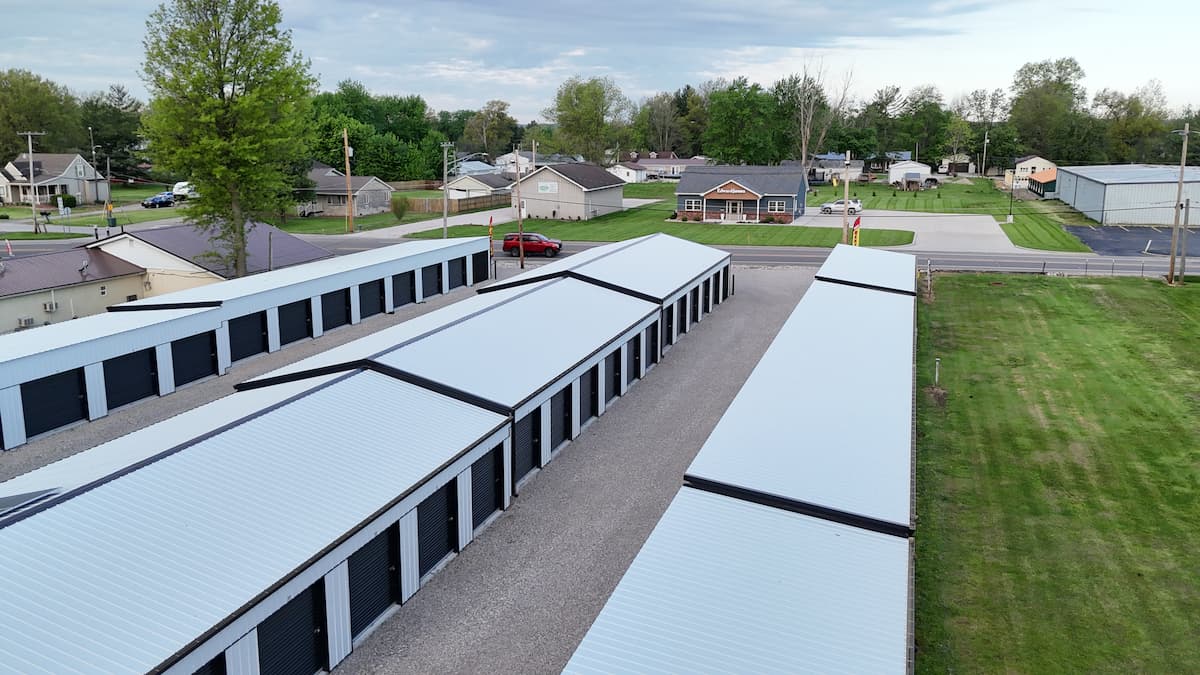
Self-Storage Facility Roofing starts with the condition of the roof in front of us
Commercial roofing for self-storage facilities, mini-storage units, and climate-controlled storage.
Life Storage maintains several large self-storage facilities in Grand Rapids, Michigan, including properties on 28th Street SW and near the East Beltline corridor, where the company serves a mix of residential movers, small business operators, and college students from nearby institutions. These facilities rely on commercial roofing systems capable of handling Michigan's demanding seasonal cycle - deep lake-effect snow loads in winter, freeze-thaw cycles through spring, and the concentrated rainfall that thunderstorm seasons bring to West Michigan.
Grand Rapids self-storage roofs face a moisture challenge from multiple directions. Winter snowfall averages over 70 inches annually, and that snow load must be accounted for in any roof assembly specified for this market. Beyond snow weight, the greater danger is ice dam formation along low-slope eaves when interior heat migrates through inadequate insulation and melts the underside of a snowpack, only to refreeze at the cold roof edge. Without proper thermal separation between the conditioned unit corridors and the roof deck, ice damming can force water under the membrane and into units before temperatures ever rise above freezing.
The solution is a roof assembly that creates a continuous thermal barrier. Polyisocyanurate insulation in thicknesses appropriate for Michigan's climate zone, combined with a mechanically fastened or fully adhered membrane, breaks the conductive pathway that drives ice dam formation. Our Grand Rapids crews pay close attention to parapet heights and edge flashing details, ensuring that any water that does form at the perimeter has a clear path to drain rather than pooling behind a parapet where it can freeze and expand against wall and deck connections.
Drainage on flat-roofed self-storage buildings in Grand Rapids must account for rapid spring melt events. When a heavy snowpack thaws in a matter of days, the volume of water hitting the roof far exceeds a standard rain event. Internal drains must be sized generously, and scupper openings should be clear of debris before winter sets in. We recommend a pre-winter inspection each fall that clears drains, confirms drain sumps are intact, and checks that emergency overflow scuppers are unobstructed - a two-hour service visit that can prevent tens of thousands of dollars in water damage claims.
For climate-controlled facilities in Grand Rapids, the roof insulation system does double duty. In summer it limits heat gain, reducing cooling costs for units storing wine collections, pharmaceuticals, or electronics. In winter it limits heat loss, reducing the burden on unit-level heating to maintain the minimum temperatures that prevent pipe freeze and mold growth. A well-insulated roof assembly with an R-value of 25 or higher is the baseline we recommend for climate-controlled operations in this market.
TPO membranes have become the dominant choice for West Michigan self-storage facilities because of their resistance to ponding water, heat-welded seam reliability, and long service life in freeze-thaw environments. Unlike EPDM, which relies on adhesive or tape seam systems that can soften in summer heat and stiffen in winter cold, TPO seams are fusion-welded at temperatures that create a bond as strong as the membrane itself. That mechanical integrity matters on a building that may not receive a thorough inspection for years at a time.
Questions We Answer Before Work Starts
How do you decide whether Self-Storage Facility Roofing needs repair or replacement?
We start with roof condition, moisture concerns, drainage, age, access, and recurring leak history. Repair is recommended when it solves the problem cleanly. Replacement is discussed when repeated repairs are only chasing symptoms.
Can the building stay open during self-storage facility roofing work?
Most commercial roof work can be staged around an active building when access, loading, noise, odors, and end-of-day dry-in are planned before crews arrive.
What do owners receive after an inspection?
Typical documentation includes photos, notes on membrane and metal conditions, drain observations, repair priorities, and a practical next-step recommendation.