

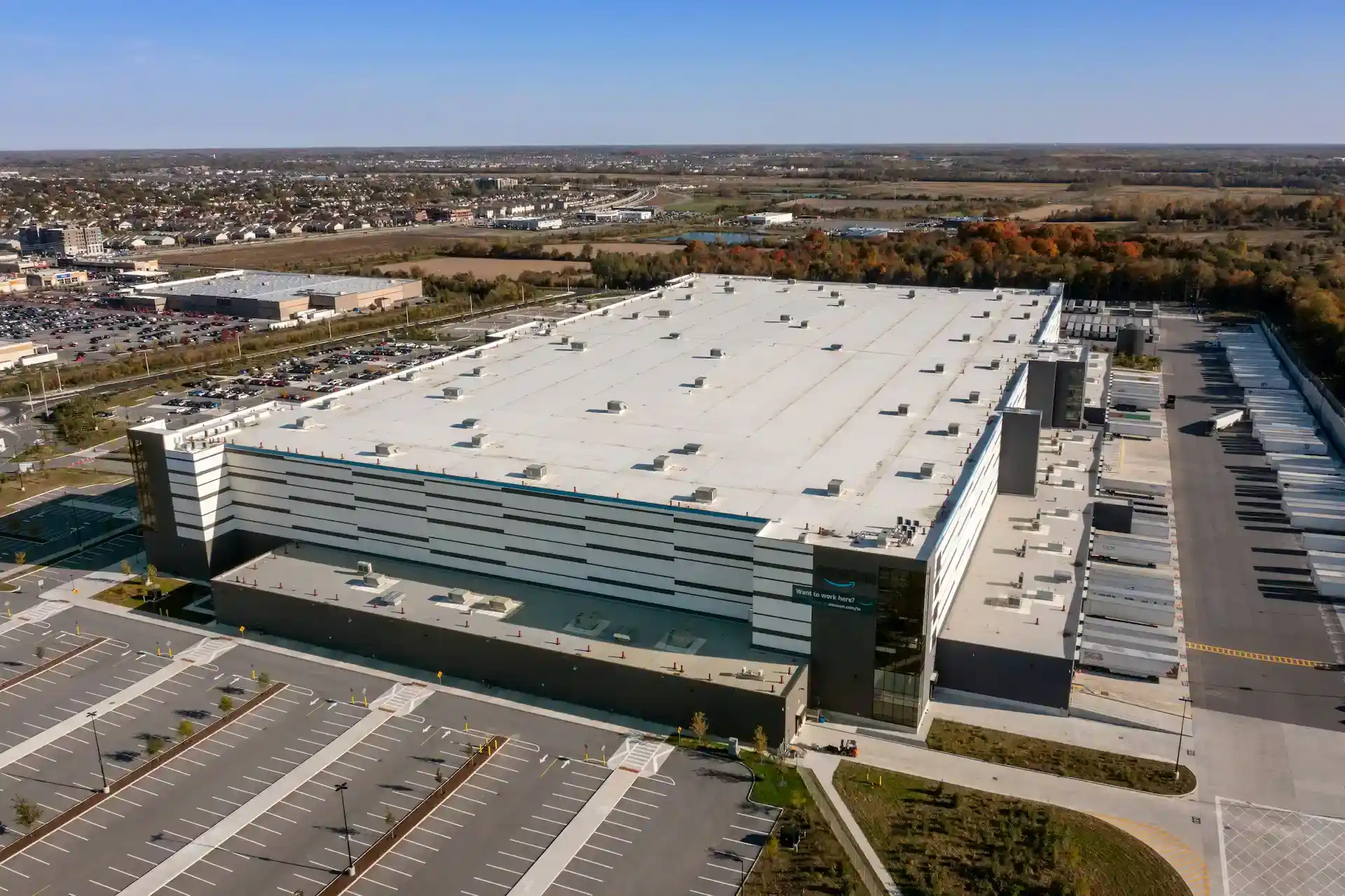
Warehouse and Distribution Center Roofing starts with the condition of the roof in front of us
Commercial roofing for warehouses, distribution centers, and industrial storage facilities.
Gordon Food Service, headquartered in Grand Rapids, operates one of the Midwest's largest private distribution networks, and its regional warehouse facilities along the I-96 and M-6 corridors represent the kind of large-footprint, refrigerated-storage roofing challenge that demands specialized expertise. West Michigan's climate is among the most demanding in the Great Lakes region - lake-effect snow from Lake Michigan can deposit two feet of wet, heavy snow in under 24 hours, adding roof loads that older distribution buildings were never engineered to accommodate without proactive monitoring and snow removal protocols.
EPDM has historically dominated the Grand Rapids warehouse roofing market due to its cold-temperature flexibility. Unlike TPO, which can become brittle and crack in sub-zero conditions during installation, EPDM remains pliable at temperatures as low as -40°F, making it the safer choice for late-fall or early-spring re-roofing work when the region's weather windows are narrow. Fully adhered EPDM in 60- or 90-mil thickness provides excellent resistance to the freeze-thaw cycling that characterizes Grand Rapids winters, where rooftop temperatures can swing 70°F between a cold night and an afternoon when solar gain warms the membrane surface well above ambient air temperature.
Snow load management is a critical design parameter for Grand Rapids distribution roofs. The Michigan Building Code requires low-slope roofs in Kent County to be designed for a ground snow load of 30 psf, but lake-effect events can create localized drifting that far exceeds that baseline load at parapets, equipment curbs, and roof-level changes. Experienced contractors evaluating a re-roofing project in Grand Rapids will always assess deck deflection patterns that indicate historical overloading, and they will often recommend installing remote snow depth sensors at drift-prone locations as part of a comprehensive roof asset management program.
Dock door flashing on Grand Rapids warehouse buildings faces the combined stress of building movement and freeze-thaw cycling. Tilt-up and precast concrete wall panels contract significantly during cold snaps, and the clearances at dock door headers that are adequate in summer can open wide enough in January to allow wind-driven rain and snow infiltration. Proper details include compressible backer rod and low-modulus sealant at the wall-to-roof interface, renewed annually as part of a preventive maintenance program before the onset of winter.
Rooftop mechanical equipment on Grand Rapids distribution buildings - exhaust fans, makeup air units, and rooftop units serving office mezzanines - creates a particularly complex waterproofing challenge because equipment curbs settle differently than the main roof deck during frost-heave cycles. All equipment curbs should be anchored to the structural deck rather than the insulation layer, and the curb-to-membrane flashing should incorporate a flexible transitional membrane that can absorb differential movement without splitting at the seam.
West Michigan's energy codes, administered under the Michigan Energy Code aligned with ASHRAE 90.1, require minimum R-30 continuous insulation on low-slope commercial roofs. Many large distribution buildings in the Grand Rapids area were built in the 1980s and 1990s with R-20 or less, and a re-roofing project presents an opportunity to bring insulation levels into compliance while improving energy performance for climate-controlled storage. Polyisocyanurate board insulation is the standard choice for these recover projects, though its R-value decreases at low temperatures, an important consideration for Grand Rapids' extended cold seasons.
Questions We Answer Before Work Starts
How do you decide whether Warehouse and Distribution Center Roofing needs repair or replacement?
We start with roof condition, moisture concerns, drainage, age, access, and recurring leak history. Repair is recommended when it solves the problem cleanly. Replacement is discussed when repeated repairs are only chasing symptoms.
Can the building stay open during warehouse and distribution center roofing work?
Most commercial roof work can be staged around an active building when access, loading, noise, odors, and end-of-day dry-in are planned before crews arrive.
What do owners receive after an inspection?
Typical documentation includes photos, notes on membrane and metal conditions, drain observations, repair priorities, and a practical next-step recommendation.