

Airport Terminal & Aviation Facility Roofing changes access, staging, and risk below the roof
Airport terminal and aviation facility roofing in Grand Rapids, MI - Gerald R. Ford International Airport and surrounding general aviation and cargo facilities.
Gerald R. Ford International Airport (GRR) is the busiest airport in West Michigan, moving millions of passengers a year and running every hour of every day. You cannot reroof a building like that on a normal commercial timeline, because there is no after-hours when the building empties out. Every access point, every material lift, and every crew deployment has to be cleared through the airport's facilities department, the FAA Part 139 safety program, and in some areas TSA security. We treat that coordination as the first deliverable of the project, settled before the contract is signed, rather than something we sort out after the crew shows up at the gate. The continued growth at GRR and the manufacturing corridor feeding it along US-131 keep steady demand for terminal, cargo, and aviation-adjacent roofing across the region.
Terminal roofs run long and flat, with minimal slope across very large fields - which makes drainage the whole game. There is almost no tolerance for ponding on a roof that big, because standing water on a low-slope deck finds seams and penetrations and a leak over a ticketing hall or a baggage system is not a maintenance ticket, it is an operational incident. Most terminal reroofing here uses a TPO or PVC single-ply over a tapered insulation system designed specifically to move water off the deck and correct the drainage deficiencies that low-slope expanses develop over time. We walk the roof with the facilities engineer and build the slope and drainage plan to match the actual deck before we settle on a membrane.
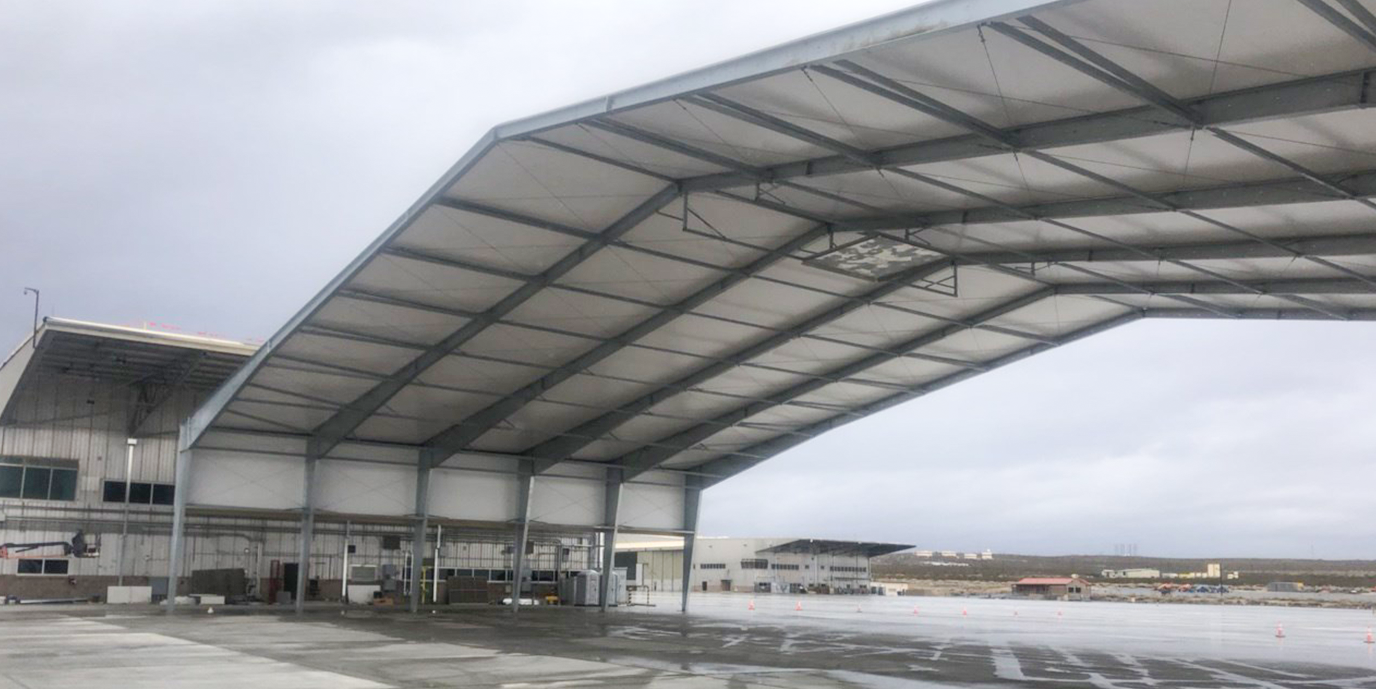
Roofs on the airside and on exposed terminal faces take wind and jet-blast exposure that a comparable logistics building never feels, and they sit in the West Michigan snow belt on top of that. Membrane adhesion, edge metal, and ballast or attachment all get specified for those loads rather than for a sheltered field condition. High-bay hangars and aviation support structures add their own twist: large clear-span roofs that generate serious wind uplift and need specific fastening patterns and seam geometry to hold. We spec and install those systems across the GRR campus and at the general-aviation fields in the area.
Terminal mechanical systems are heavier and far more numerous than standard commercial, which means a high count of curbed penetrations and complex through-deck details, each engineered individually rather than flashed to a stock pattern. Our pre-project survey documents every curb height, clearance, and penetration before the work plan is set. And the badging requirement does not stop at the terminal door - cargo facilities, rental-car centers, FBO hangars, maintenance buildings, and on-campus hotels all carry the same access discipline. We do not put a crew member on any part of an airport campus without confirmed authorization, and on airside zones near active aprons and gates that credentialing and the extra pre-planning are built into the bid timeline, coordinated with airfield operations and the FAA NOTAM process where required.
Travelers and operators using the region also rely on secondary fields, and the building types there are often more demanding even though the security is lighter. Aviation work near Grand Rapids spans GRR itself plus general-aviation and reliever options in the surrounding area:
For FBOs, private hangars, and reliever-field structures, we handle everything from a single-bay hangar to a multi-unit complex, with the clear-span uplift and thermal-movement detailing those buildings require.
Questions We Answer Before Work Starts
How do you decide whether Airport Terminal & Aviation Facility Roofing needs repair or replacement?
We start with roof condition, moisture concerns, drainage, age, access, and recurring leak history. Repair is recommended when it solves the problem cleanly. Replacement is discussed when repeated repairs are only chasing symptoms.
Can the building stay open during airport terminal & aviation facility roofing work?
Most commercial roof work can be staged around an active building when access, loading, noise, odors, and end-of-day dry-in are planned before crews arrive.
What do owners receive after an inspection?
Typical documentation includes photos, notes on membrane and metal conditions, drain observations, repair priorities, and a practical next-step recommendation.