

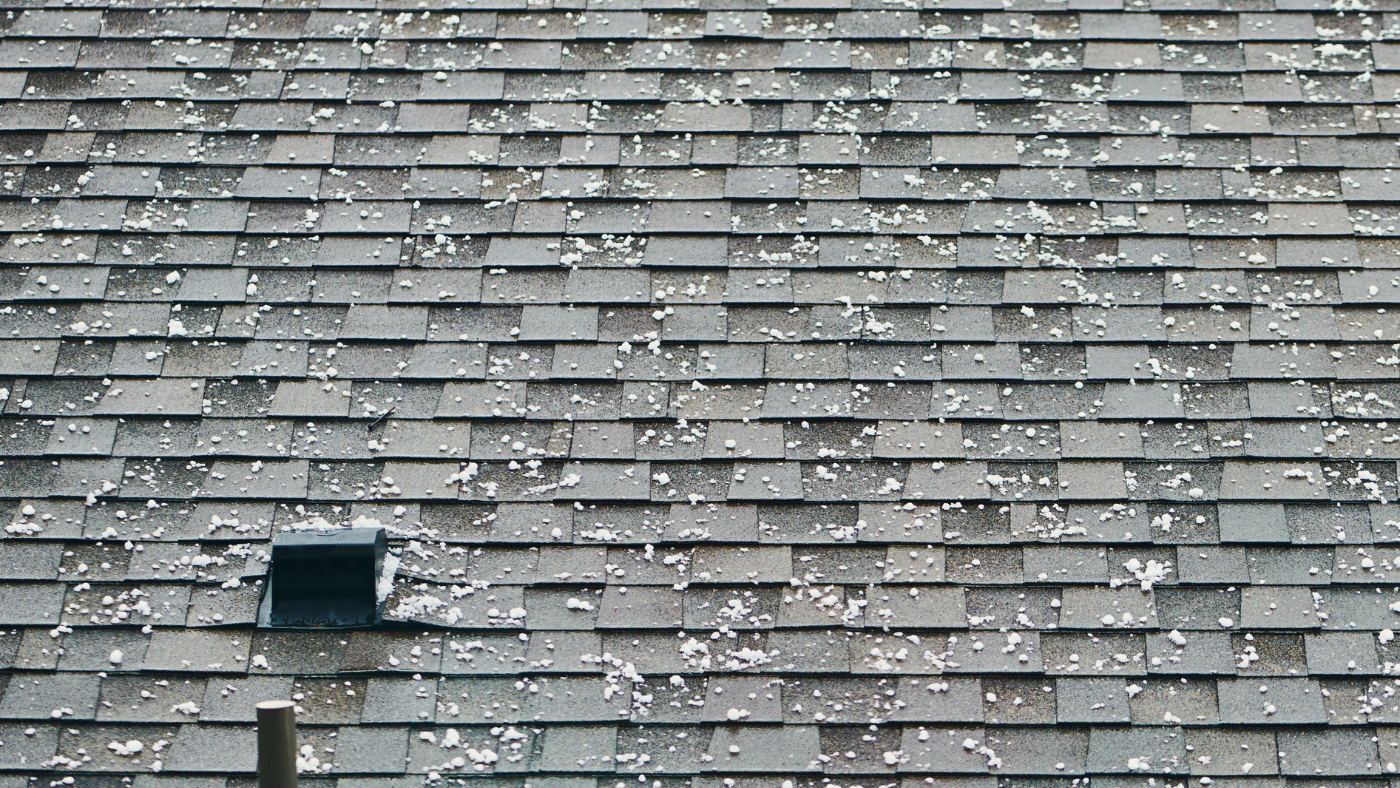
Hail damage on a low-slope commercial roof rarely looks dramatic from the ground, which is exactly why so many hail claims get scoped down or denied. A bruised membrane or a dented pipe boot doesn’t announce itself the way a cracked windshield does. Catching it, measuring it, and tying it to the storm date before anyone else walks the roof is most of what decides whether a hail claim holds up.
We’re your roofing contractor, not a public adjuster , we document and substantiate the roof damage so you and your adjuster work from an accurate scope. On hail claims, that starts with knowing what real hail damage looks like on a commercial roof system, which is different from what it looks like on shingles or a vehicle.
On single-ply membranes like TPO or PVC, hail bruising can fracture the reinforcing scrim beneath the surface without breaking the membrane open, which means the damage is only findable through close inspection, not a drive-by look. Modified bitumen shows granule loss and surface fracturing. Metal accessories , coping, counterflashing, pipe boots, rooftop unit cabinets , dent in a pattern that’s consistent across the roof when hail caused it, which is one of the clearest signs we look for.
Our approach is to map the roof in zones and log damage consistently across each one, rather than photographing only the worst-looking spot. A hail event that hit hard enough to dent metal accessories rooftop-wide usually left a matching pattern on the membrane in the same zones, even where that damage is harder to see. Establishing that consistent, roof-wide signature is what separates a documented hail event from a handful of isolated marks an adjuster might attribute to something else.
A complete hail scope accounts for matching as much as it accounts for the damage itself. If a section of membrane needs replacement, we note whether the remaining field can be matched in color, texture, and manufacturer without a visible seam , because a patched roof with a mismatched panel is still a functional problem, not a cosmetic one. We also scope every damaged accessory in a zone rather than just the worst example, since a scope that fixes one dented pipe boot and leaves three others in the same condition invites a callback.
Insurers sometimes push back on whether hail marks are functional damage or purely cosmetic. We document that distinction directly , a fracture in the membrane’s reinforcement or a coating that’s lost its protective integrity is a functional concern even if it isn’t leaking yet, because it shortens the roof’s remaining service life and creates a future entry point for water. We give the adjuster the technical language to support that determination.
West Michigan gets fewer hail events than the Plains states, but the ones that come through spring and summer severe thunderstorm outbreaks are real and can be significant. Grand Rapids’ furniture-industry campuses carry expansive single-ply roof fields where a hail-zone map is straightforward to build section by section. The medical mile’s dense rooftop mechanical equipment gives hail more surfaces to dent alongside the membrane itself. Downtown, brewery and adaptive-reuse buildings often have smaller, more complex rooflines where hail damage can hide behind parapets and around rooftop clutter. The distribution buildings along US-131 and I-96 have continuous roof fields large enough that hail intensity can vary from one end of the building to the other.
Timing matters here too. Documenting hail damage before the next storm, before a hard freeze, and before UV exposure continues to degrade an already-weakened membrane gives the clearest possible read on what the hail itself did versus what happened afterward.
If a hailstorm has come through and you’re not sure whether the roof took real damage, a roof review will tell you either way , and if it did, you’ll have a documented, zone-by-zone record ready before the adjuster’s visit.
Questions We Answer Before Work Starts
How do you tell hail damage from normal wear on a membrane roof?
We look for a consistent damage pattern across roof zones , bruising, granule loss, or scrim fracture that lines up with dented metal accessories in the same areas. Normal wear tends to concentrate at high-traffic or high-exposure spots rather than matching a storm-wide pattern.
Will a small hail dent on metal accessories affect our claim?
Individually, a single small dent might seem minor, but a consistent pattern of dents across coping, pipe boots, and rooftop unit cabinets is strong supporting evidence for a hail event, even where the membrane damage itself is harder to see.
How soon after a hailstorm should the roof be inspected?
As soon as it’s safe to access. UV exposure, subsequent weather, and normal roof traffic can all obscure or add to hail marks the longer an inspection is delayed, making it harder to build a clean, storm-specific record.
What if the insurance adjuster says the damage isn’t storm-related?
We provide the technical documentation , zone mapping, accessory dent patterns, membrane fracture evidence , that supports why the damage is consistent with the reported hail event. From there, how that evidence is used in the claim is between you and your insurance company.
Do you replace only the damaged sections or the whole roof?
It depends on the extent of the pattern and whether replaced sections can be matched to the surrounding field. We document both options where the roof is a genuine borderline case so the scope reflects the real extent of the damage rather than the smallest possible repair.