

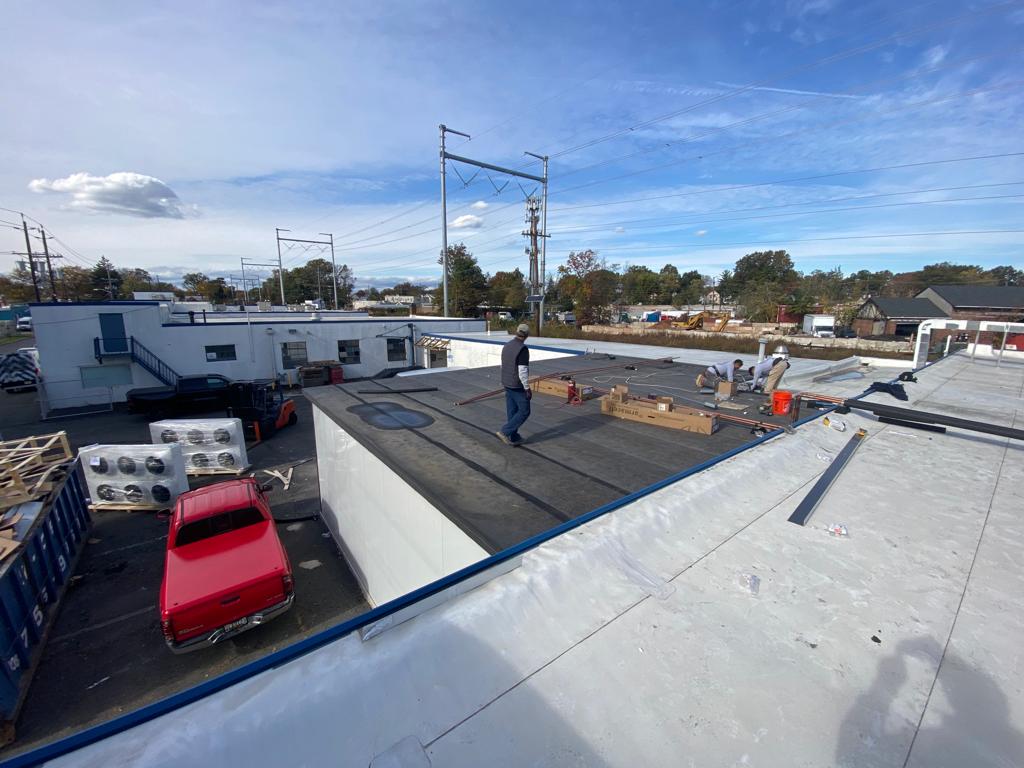
Food Processing Facility Roofing changes access, staging, and risk below the roof
Washdown humidity rising from below, heavy refrigeration loads on top, and a regulator who treats a leak as a food-safety event. We roof processing plants for all of it.
Food processing is one of the few building types where the roof is loaded hard from below and from above at the same time. Inside, daily sanitation washdown drives heat and moisture up against the underside of the deck, so the assembly has to manage vapor drive the same way a cold-climate building does. On top, the plant stacks refrigeration condensers, ammonia or glycol equipment, large make-up air units, and process exhaust, concentrating heavy point loads and constant vibration over specific bays. Get either side wrong and you do not always see a drip first; you see deck corrosion and wet insulation building quietly inside the assembly. We plan these roofs around moisture management, not just keeping rain out.
Grand Rapids has deep roots in food and beverage, which is why this work is steady here. West Michigan grows a serious share of the state's apples, blueberries, and produce, and that feeds packers, processors, and cold storage across the region. The food cluster runs from the long-standing operations near the Wealthy Street and Godfrey Avenue industrial belt on the southwest side, out through the Walker and Comstock Park industrial parks, and into the agricultural-processing operations ringing the metro. Add the city's well-known brewing and beverage scene and you have a steady base of buildings with washdown humidity and refrigeration loads sitting under aging roofs.
On a USDA- or FDA-regulated line, the roofing material is not just a performance choice, it is a compliance item. Not every commercial membrane is acceptable above a food-contact or open-product zone, and the question goes beyond the membrane itself to the adhesives, primers, and sealants in the flashing details, many of which carry solvents that are not welcome in a production environment. Before we spec anything over a production area we confirm acceptability against the plant's food-safety plan with the QA team. White TPO and PVC single-ply are generally workable above enclosed processing, but the specific product and install method still get verified rather than assumed.
Most processing plants here run two or three shifts with one weekly sanitation window as the only time the floor is truly down. Any work that opens the envelope above an active production area has to live inside that window, with QA confirming the floor is clean and protected before we start and after we finish. We build the phasing around the production calendar instead of asking the plant to bend to ours, and we keep the open area watertight at every handoff. Work above refrigerated rooms gets coordinated with the refrigeration maintenance team so nothing we do interrupts the cold chain.
Freezer rooms, chill rooms, and blast-freeze areas change the rules for the roof above them. The assembly has to maintain thermal continuity so the temperature difference between a deep-freeze room and a humid plant does not drive condensation inside the roof. Tapered insulation over a refrigerated bay in Michigan has to be designed around the actual operating temperatures and the vapor-drive direction for our climate, with the vapor retarder placed correctly for that drive. Done wrong, you get hidden condensation that corrodes the deck and wets the insulation with no external leak ever showing up, which is exactly the failure that turns into a structural problem before anyone notices.
Ponding water is bad on any roof; over a freezer room it is worse, because standing water adds thermal load that the refrigeration system then has to fight, on top of feeding deck corrosion. We design tapered systems to pull water off the refrigerated bays to scuppers or interior drains at the low point and confirm the drainage layout matches what the refrigeration design expects overhead. When a leak does happen over an active line, we treat it as the food-safety event the plant has to, with fast temporary dry-in and documentation the QA team can use for its own reporting.
Questions We Answer Before Work Starts
How do you decide whether Food Processing Facility Roofing needs repair or replacement?
We start with roof condition, moisture concerns, drainage, age, access, and recurring leak history. Repair is recommended when it solves the problem cleanly. Replacement is discussed when repeated repairs are only chasing symptoms.
Can the building stay open during food processing facility roofing work?
Most commercial roof work can be staged around an active building when access, loading, noise, odors, and end-of-day dry-in are planned before crews arrive.
What do owners receive after an inspection?
Typical documentation includes photos, notes on membrane and metal conditions, drain observations, repair priorities, and a practical next-step recommendation.